Back to blog

How Do Club Owners Use Weekly Metrics to Fill Courts?

How Do Club Owners Use Weekly Metrics to Fill Courts?

Court utilization and weekly club metrics for padel and tennis club owners: peak demand, empty courts, retention, and plays to grow club revenue this week.

· · By Smash Team · 7 min read

Padel, tennis, and pickleball club owners already feel whether courts are busy. Gut feel rarely explains why revenue stalls or where growth is hiding.

Smash shows weekly club metrics (court utilization, peak demand, blocked time, retention, app adoption, unpaid balances, reviews, and booking lead time) so you can act the same week: fill empty courts, protect prime inventory, and grow club revenue without waiting for a month-end report.

This guide is for owners running a multi-sport racket club or a single-sport padel or tennis venue. Make it a Monday habit: open Overview, pick one soft gap, and fix it before the weekend rush.

Jump to a metric

How can I identify promotional opportunities based on peak demand?

Peak Demand KPI card showing Evening as the busiest daypart

Smash shows when demand already piles up so you stop aiming campaigns at hours that are full. A strong evening peak is normal for working adults. The opportunity is everything else: weekday mornings, early afternoons, and soft midweeks.

What to look for

  • Evening-heavy weeks mean promo energy belongs off-peak, not on Friday night discounts.
  • Twin peaks (evening and weekend morning) still leave weekday midday soft. That is your clinic and mixer band.
  • If peaks shift after new programming, treat that as feedback that the calendar moved demand.

Plays that grow court utilization and club revenue

  1. Price the soft hours deliberately. Lower rates or membership windows for mornings and early afternoons, sold as quiet court time. See how to fill off-peak court slots.
  2. Put clinics and mixers in the quiet band. A daytime social or coach clinic fills courts and creates returning players.
  3. Protect prime inventory. Do not discount the peak first.
  4. Say the gap in the ad. “Tuesday to Thursday before 4pm: courts available” beats a generic “book now.”

How do club owners use court utilization this week to spot empty courts?

Utilization This Week KPI card with percentage and week-over-week change

Smash shows how full this week already is, and whether that is better or worse than last week, so empty courts show up while you can still act. Pair it with peak demand so a “healthy” midweek total does not hide empty mornings.

How to read it

  • Mid-60s utilization can still mean soft mornings. Look at the quiet band, not only the headline %.
  • A sharp drop versus last week is an early warning: weather, holidays, competing events, or a price change.
  • Rising utilization with last-minute booking habits often means walk-in demand worth testing with dynamic off-peak offers.

Operational moves

  1. Triage empty hours every Monday. Open play, corporate blocks, or fewer fake holds.
  2. Aim for a healthy band, not 95%. Leave room for coaches and events.
  3. React to trends, not one rainy week. Three soft weeks in a row is a campaign problem.
  4. Act the same day. Seed an event or price rule into the soft hours before the weekend.

For a heatmap of quiet windows and AI ideas on one gap, see how to turn quiet court slots into bookings.

Am I blocking too much capacity that players could book?

Blocked Capacity KPI card showing percentage of court-hours closed

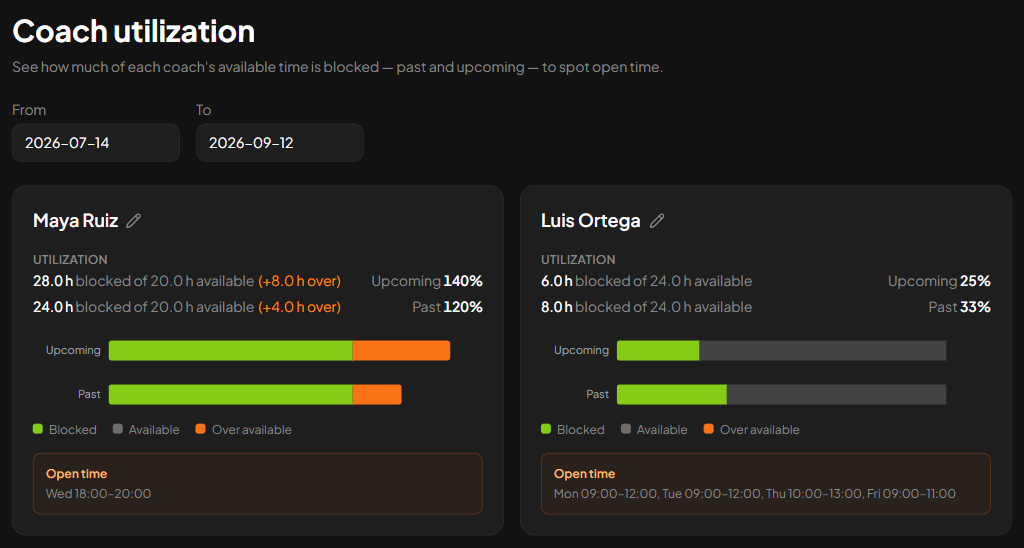
Smash shows how much bookable time is closed to players. Coaching and real events belong on the calendar. Recurring “busy” holds with no coach, event, or paying client silently starve mobile bookers.

Healthy vs hazardous

  • Named coaching and tournaments are healthy blocks.
  • Placeholder holds that never convert are silent churn.
  • Rising blocked time with flat utilization usually means the grid is over-protected.

Cleanup checklist

  1. Audit recurring holds monthly and cut anything without a named purpose.
  2. Prefer dated one-offs over perpetual patterns.
  3. Publish events that justify long blocks, or reopen leftover courts.
  4. Train staff: every block needs who it is for, until when, and how unused time returns.

If evenings are full while blocked time is high, you may be hiding the only hours players want.

How can I tell if players are returning or mostly booking once?

Returning Bookers KPI card with returning and new booking shares

Smash shows whether bookings come from players who have been before or from first-timers. Acquisition fills the funnel; retention fills the P&L. High return play means community. Mostly new means you are renting courts to strangers.

Growth levers

  1. Close the second visit with a follow-up offer or bring-a-friend evening.
  2. Lean on leagues and recurring slots so new players become habits.
  3. Fix no-shows and flaky cancels that make the club feel unreliable.
  4. Link guests to profiles so retention is visible, not guesswork.

For community plays that keep people coming back, see how to stand out in a crowded racket market.

Are enough players managing bookings through the Smash app?

App accounts KPI card with linked players and new links this month

Smash shows how much of your base can book, pay, and get notified without the desk. Desk-only booking does not scale. App-linked players fill off-hours, pay online, and become your best promo list.

Adoption plays

  1. Make the first booking digital (QR at reception, “book next time in the app”).
  2. Reward linking with small perks or priority waitlists.
  3. Watch whether new players link, not only the lifetime total.
  4. Combine linked players with followers when you promote soft hours.

Higher app adoption makes every other weekly metric more accurate and actionable. Explore Smash for clubs on our for clubs pages.

Where is cash stuck in pending payments?

Pending Payments KPI card with count and amount due

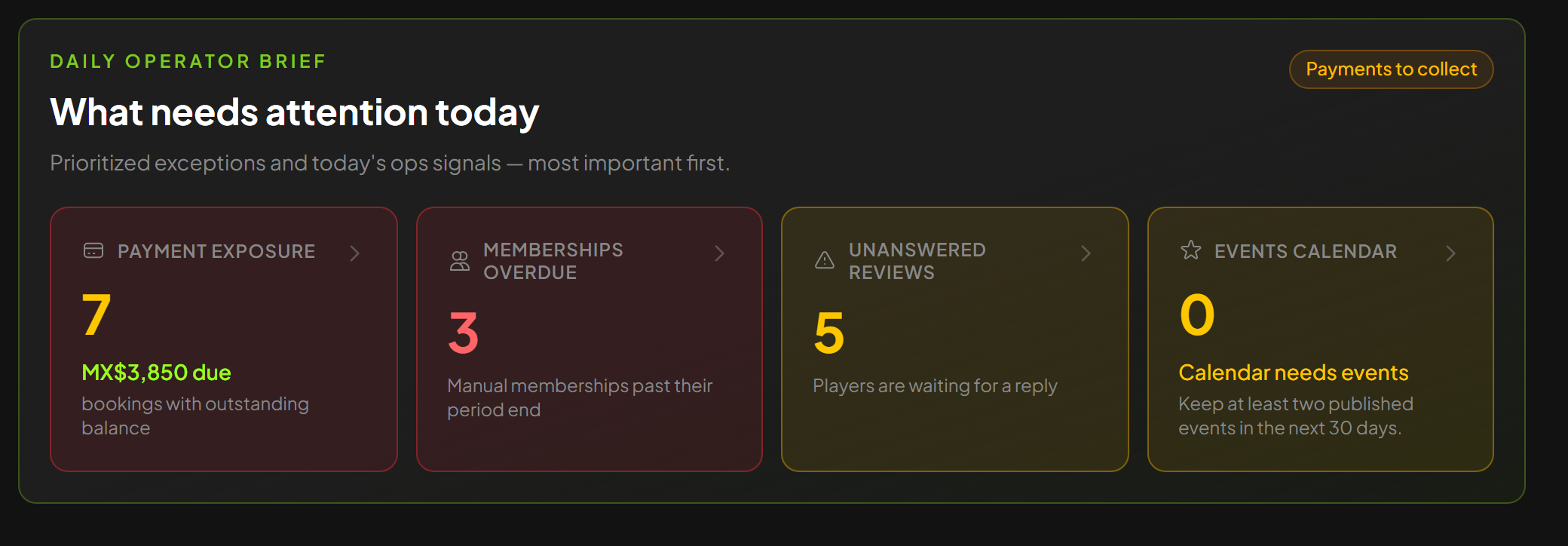
Smash highlights unpaid bookings before they become a surprise. Treat them as receivables: unpaid holds block inventory and create write-off risk.

Collection playbook

  1. Clear outstanding balances daily with one owner and a simple reminder sequence.
  2. Prefer online payment defaults where policy allows.
  3. Tighten deposits on peak evenings when inventory is scarce.
  4. Escalate repeat unpaid names with notes or booking limits.

A near-empty pending list is a culture signal: the club books for money, not goodwill IOUs.

How should I use reviews and unanswered replies to grow trust?

Reviews KPI card with star rating, unanswered count, and reply rate

Smash shows how you look online and what still needs a human reply. Players comparing clubs notice unanswered threads. Online reputation shapes that choice as much as star averages.

Weekly reputation habit

  1. Answer everything within 48 hours, especially critical reviews.
  2. Celebrate recent wins on social and in newsletters to fill off-peak.
  3. Connect review themes to ops (for example “no courts” while blocked time is high).
  4. Aim for high reply rate, not only high stars.

Unanswered reviews waste trust you already earned. Browse more club ops ideas in our club resources hub.

What does average booking lead time tell me about when to promote?

Avg Lead Time KPI card showing average days between booking and play

Smash shows how far ahead players commit so campaigns stop shouting at empty calendars. Multi-day planners need earlier league and price launches. Same-day bookers need “courts free tonight” messages.

Timing your marketing calendar

  1. Match promo timing to how far ahead people book.
  2. Release peak inventory earlier when lead times stretch.
  3. Keep a last-minute lane for impulse and off-peak fills.
  4. Watch lead time after deposit or cancellation changes; commitment often lengthens.

Put it together: a simple weekly metrics ritual

  1. Monday: Empty courts, peak vs soft hours, and fake blocks. Use quiet-slot heatmaps and AI ideas when you want one gap to fill this week.
  2. Midweek: Unpaid balances and when to push remaining promos.
  3. Friday: Whether players are returning and booking in the app.
  4. Anytime unanswered reviews pile up: Protect reputation before the weekend.

You do not need every metric every day. You need one honest read of demand, capacity, retention, digital adoption, cash, and trust, then one concrete change.

Open weekly metrics in the Smash Club Dashboard, pick the first soft gap you see, and turn it into this week’s growth job.

Share this post