

Weekly Club Metrics Club Owners Use to Fill Courts
Court utilization and weekly club metrics for padel and tennis club owners: peak demand, empty courts, retention, and plays to grow club revenue this week.
· · By Smash Team
- club-management
- club-owners
- court-utilization
- revenue
- operations
Padel, tennis, and pickleball club owners and managers already feel whether courts are busy. Gut feel alone rarely tells you why club revenue stalls or where growth is hiding. Weekly club metrics—especially court utilization, peak demand, and blocked capacity—turn everyday booking activity into decisions you can act on the same week: when demand peaks, how many empty courts you leave on the table, who comes back, who books in the app, which balances are unpaid, how reputation is trending, and how far ahead members book.
This guide is for club owners running a multi-sport racket club (or a single-sport padel or tennis venue). For each metric you will see what it means, what a healthy reading usually looks like, and concrete plays: pricing, promos, block-off hygiene, retention, app adoption, collections, and review replies. The Smash Club Dashboard surfaces these numbers so club management stays a Monday ritual, not a month-end autopsy.
Make weekly club metrics an ops habit. Open them Monday morning, scan the cards below, pick one gap, and fix it before the weekend rush.
Jump to a metric
- How can I identify promotional opportunities based on peak demand?
- How do club owners use court utilization this week to spot empty courts?
- Am I blocking too much capacity that players could book?
- How can I tell if players are returning or mostly booking once?
- Are enough players managing bookings through the Smash app?
- Where is cash stuck in pending payments?
- How should I use reviews and unanswered replies to grow trust?
- What does average booking lead time tell me about when to promote?
How can I identify promotional opportunities based on peak demand?
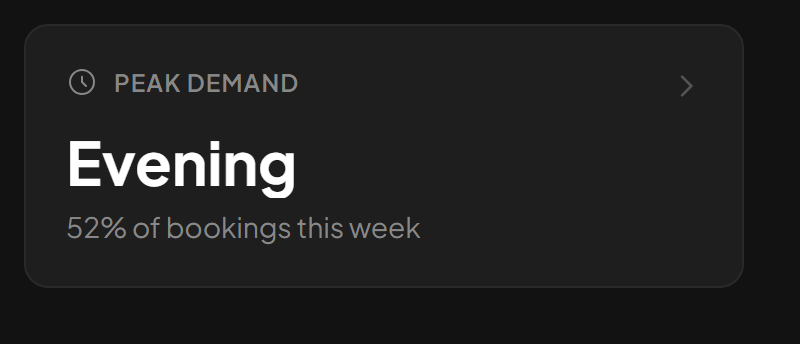
Peak Demand summarizes which dayparts dominate bookings this week: morning (roughly 05:00 to 12:00), afternoon (12:00 to 17:00), or evening (17:00 to 24:00). The card highlights the busiest period and the share of week bookings that fell there. Click the card to jump into Availability and inspect the actual grid.
What to look for
- A strong evening peak (often 45% to 60%+) is normal for working adults. The opportunity is rarely “more evening”; it is everything else.
- A twin peak (evening and weekend morning) still leaves weekday midday soft. That soft window is your promo opportunity.
- If peaks shift week to week after clinics or league launches, treat Peak Demand as feedback on whether programming moved demand.
Plays that grow court utilization and club revenue
- Price the off-peak deliberately. When Peak Demand is evening-heavy, introduce lower rates or membership windows for mornings and early afternoons, then advertise them as “quiet court time.” Our guide to filling off-peak court slots covers pricing and programming plays in more detail.
- Schedule clinics and mixers into the quiet band. A daytime social mixer or coach clinic fills courts and creates future returning bookers.
- Do not discount the peak first. Protect prime evening inventory. Use promos to redistribute demand rather than erode average booking value on full courts.
- Align marketing copy with the gap. “Tuesday to Thursday before 4pm: courts available” converts better than a generic “book now” blast.
Peak Demand answers: when are we already full, and when should campaigns and events aim?
How do club owners use court utilization this week to spot empty courts?
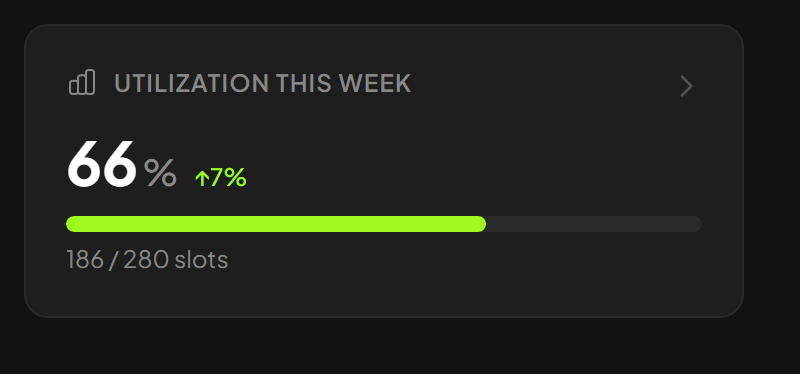
Court utilization this week (Utilization This Week on the card) is the share of open slots—based on opening hours through today—that are already booked, with a week-over-week delta for the same elapsed window. A lime progress bar makes it easy to see at a glance. The card deep-links to Availability. For club owners, this is the fastest read on empty courts leaving money on the table.
How to read it
- Mid-60s court utilization midweek can still hide empty mornings. Combine this card with Peak Demand.
- A sharp ↓ versus last week is an early warning: weather, school holidays, competing events, or a price change.
- Rising utilization without rising lead time sometimes means last-minute walk-in demand. That pattern is useful for dynamic pricing experiments.
Operational moves
- Inventory triage every Monday. Note courts or hours with chronic empty slots and either open them to open play, partner corporate bookings, or cut unnecessary block-offs.
- Protect growth, not vanity. Chasing 95% can mean zero room for coaches and tournaments. Aim for a target band that fits your mix (many clubs thrive in the mid-70s with intentional programming).
- Watch week-over-week before reacting. One slow rainy week is noise; three consecutive ↓ weeks is a campaign or pricing problem.
- Use Availability to act. Click the card, filter soft hours, and seed an event or price rule the same day.
Empty open slots are perishable. Court utilization is the club owner’s fastest “are we leaving money on the table?” check.
Am I blocking too much capacity that players could book?
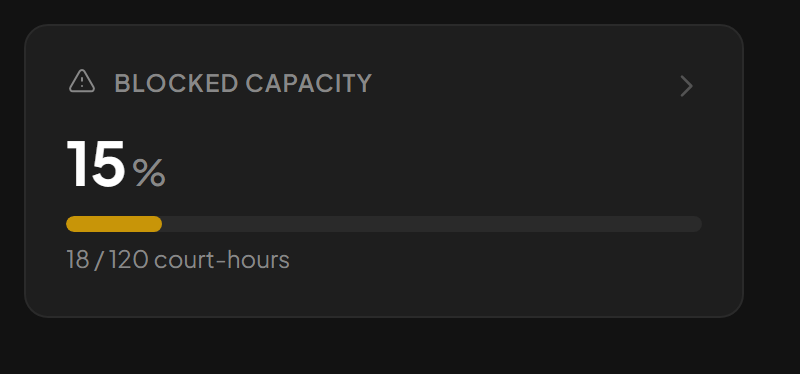
Blocked Capacity measures what share of this week’s open court-hours is closed by block-offs (maintenance, private coaching holds, tournaments, staff placeholders). The yellow progress bar signals friction: blocked time is invisible to players who want to book. The card opens Schedule, then the block-offs tab.
Healthy vs hazardous
- Some blocked share is healthy. Real coaching and events belong on the calendar.
- Recurring blocks that never convert to confirmed activity (placeholder “busy” courts) are silent churn for mobile bookers who see no slots.
- A climbing blocked % with flat court utilization usually means the grid is over-protected.
Cleanup checklist
- Audit recurring block-offs monthly. Delete or shrink holds that do not have a named coach, event, or paying client.
- Prefer dated one-off blocks for temporary needs instead of perpetual patterns.
- Publish events that justify long blocks. If a weekend is blocked for a tournament, make sure RSVPs and marketing exist. Otherwise, reopen leftover courts.
- Train staff. Every block should answer: who is this for, until when, and how do we release unused time?
If Peak Demand says evenings are full while Blocked Capacity is high, you may be starving the only hours players want.
How can I tell if players are returning or mostly booking once?
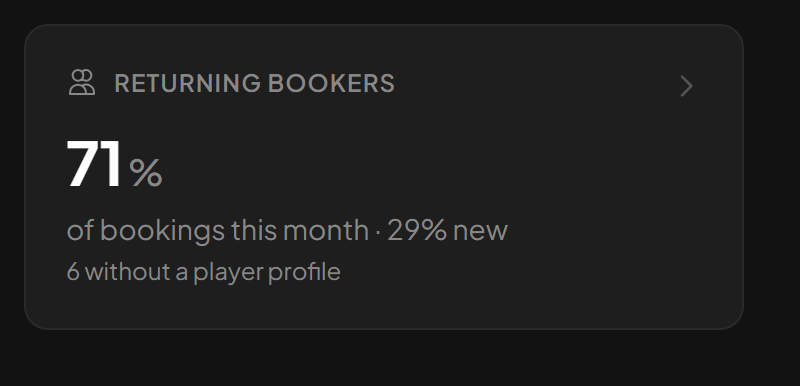
Returning Bookers shows month-to-date mix: what percentage of attributed bookings come from players who have booked before versus first-time bookers. Unattributed walk-ins without a player profile are called out separately. The card links to Bookings.
Why it matters for club owners
Acquisition fills the funnel; customer retention fills the P&L. Clubs that stay stuck near “mostly new” spend forever on awareness while courts feel inconsistent. A high returning share means your community is sticking; a low share means you are renting courts to strangers.
Growth levers
- Close the second visit. After a first booking, prompt a follow-up via SMS/email, intro offers, or “bring a friend” evenings. Next month’s returning share tells you whether those plays worked.
- Lean into leagues and recurring slots. Standing weekly games turn new bookers into returning ones by design.
- Fix no-shows and cancellations that make players feel your club is unreliable (policies, reminders, deposits).
- Link guests to player profiles. Unattributed bookings hide retention truth. Encourage app accounts or staff capture at the desk.
Track returning % monthly the way hotels track repeat guests. Rising returning share is one of the strongest signals your club is becoming a habit, not a one-off. For community and differentiation plays that keep players coming back, see our playbook for standing out in a crowded racket market.
Are enough players managing bookings through the Smash app?
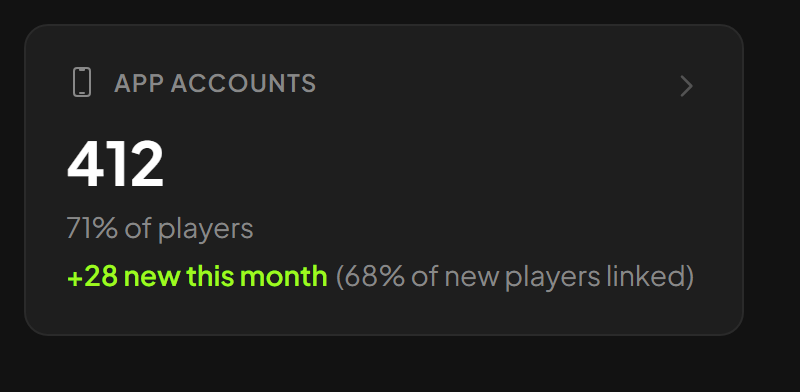
App accounts counts players with a linked Smash user (self-serve booking identity), the share of your player base they represent, and how many new players linked this month. It deep-links to Players.
Why app adoption is a management metric
Desk-mediated bookings do not scale. App-linked players book off-hours, pay online more readily, receive push and email, and show up in Followers for marketing. Low app % means your weekly club metrics (and your staff) are missing part of the picture. Smash is built for self-serve booking. Explore the product on our for clubs pages.
Adoption plays
- Make the first booking digital. QR codes at reception, “book next time in the app” receipts, and staff scripts beat poster campaigns.
- Incentivize linking. Small credits, priority waitlists, or member perks for app-linked profiles.
- Watch “% of new players linked.” If total app accounts grow but new-player link rate is weak, onboarding is broken. Fix the first-week journey.
- Combine with Followers. Linked players who stay opted-in are your highest-ROI promo list for filling Peak Demand gaps.
Think of App accounts as the digitization meter for your club. The higher it climbs, the more the rest of your weekly club metrics become accurate and actionable.
Where is cash stuck in pending payments?
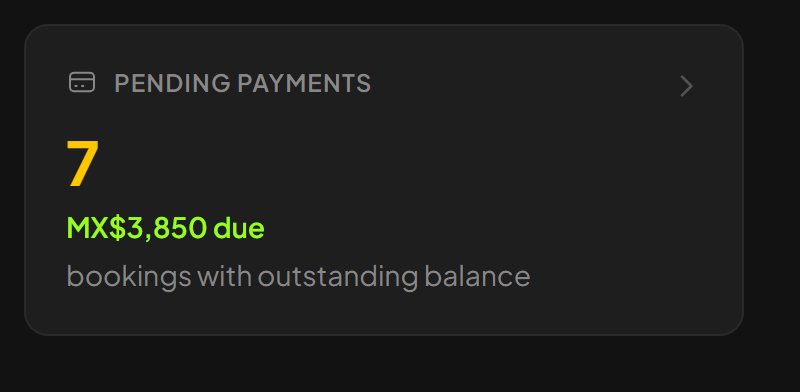
Pending Payments shows how many bookings still have an outstanding balance and the amount due. Yellow counts signal urgency. Click through to Bookings filtered to pending payment status.
Treat it like aged receivables
Pending balances are not “almost revenue.” Treat them as accounts receivable: friction from unpaid holds that block inventory, awkward desk conversations, and write-off risk. This card surfaces the pile so club owners do not discover it only when payroll is due.
Collection playbook
- Daily clear the yellow. Assign one staff owner to chase due balances with a polite, templated reminder sequence.
- Prefer online payment defaults. Reduce new pending by requiring online payment for app bookings where policy allows.
- Tighten deposit rules for peak. Evening Peak Demand slots should not sit unpaid while nearby evening inventory is scarce.
- Escalate chronics. Recurring pending names may need profile notes, deposits, or booking restrictions.
A clean Pending Payments card (zero or near-zero) is a culture signal: your club books for money, not goodwill IOUs.
How should I use reviews and unanswered replies to grow trust?
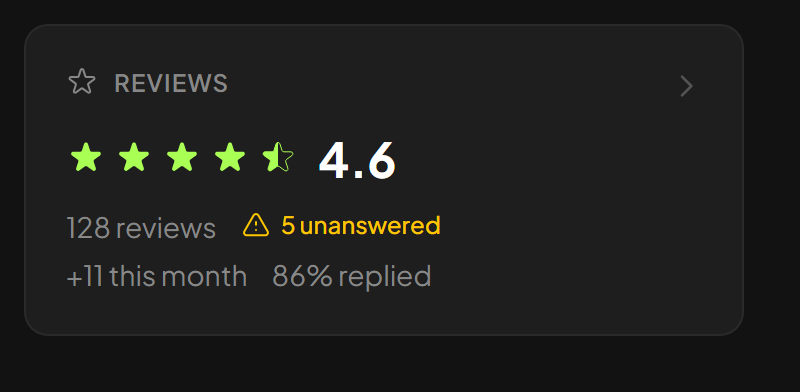
Reviews shows average rating, total volume, unanswered count, new reviews this month, and lifetime reply rate. Click into Reviews to answer players.
Reputation drives bookings
Players comparing clubs online will choose the active, answered community over a silent 4.8. Online reputation shapes that choice. Unanswered counts are the actionable gap. They are unresolved conversations, not vanity metadata.
Weekly reputation habit
- Answer everything within 48 hours, especially critical reviews. Acknowledge, invite offline resolution, and never argue in public.
- Celebrate wins on social. Positive monthly velocity (+N this month) belongs in stories and newsletters. Social proof helps fill off-peak. Browse more club ops ideas in our club resources hub.
- Connect product issues to the numbers. Clusters of comments about “no courts available” while Blocked Capacity is high mean your ops metrics and reviews are telling the same story.
- Aim for high reply rate, not just stars. A 4.6 with 86% replied often outperforms a quieter 4.9.
Reviews convert court utilization and retention into trust. Leaving them unanswered wastes the marketing you already earned.
What does average booking lead time tell me about when to promote?
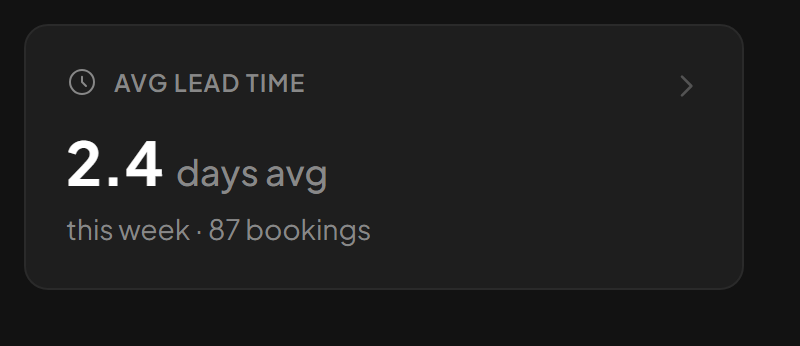
Avg Lead Time is the mean gap from booking created to session start for bookings this week, shown in days or hours when under a day, with sample size. It links to Bookings.
Interpreting advance vs last-minute clubs
- Multi-day lead times mean players plan ahead. Launch weekend leagues, price rules, and sellouts earlier; last-minute promo blasts will miss them.
- Same-day / few-hour lead times mean walk-in and impulse demand. Afternoon SMS and “courts free tonight” messaging win; long-horizon campaigns underperform.
- Mix both: evenings may book early while midday is last-minute. Pair Lead Time with Peak Demand.
Timing your marketing calendar
- Schedule promos to match lead time. If average is about 2 to 3 days, start Monday midweek-gap campaigns by Monday noon, not Friday night.
- Release peak inventory earlier when lead time stretches. Waitlists and membership priority booking reward planners.
- Keep a last-minute lane for short lead-time segments: open play, discounted singles, or dynamic off-peak releases.
- Watch after policy changes. Deposits and cancellation windows often lengthen lead time (players commit sooner). Confirm on this card.
Lead time tells club owners when attention converts to bookings so campaigns stop shouting at empty calendars.
Put it together: a simple weekly metrics ritual
- Monday: Court utilization, Peak Demand, and Blocked Capacity. Find empty inventory and clear fake blocks.
- Midweek: Pending Payments and Lead Time. Collect cash and time remaining promo shots.
- Friday: Returning Bookers and App accounts. Check whether community and digital adoption moved.
- Anytime unanswered reviews > 0: Reviews. Protect reputation before the weekend.
You do not need every metric every day. Club owners need one honest read of demand, capacity, retention, digital adoption, cash, and trust, then one concrete change.
Open your club’s weekly club metrics in the Smash Club Dashboard, pick the first yellow or soft gap you see, and turn that number into this week’s growth job.